

3 Things to Know Before Signing a California Purchase Agreement
The RPA, short for the California Residential Purchase Agreement and Joint Escrow Instructions, is the legally binding contract you sign when you make an offer on a home in California. Most buyers spend all their energy negotiating price and then skim through the rest of it to get to closing. Three sections of that 17-page contract matter more to your money and your protection than almost anything else in it, and most buyers never really read them until they need them.
Here's what actually matters, based on the current California Residential Purchase Agreement (revised 12/25).
A quick note before we get into it: the purchase agreement itself is 17 pages, but the full package a buyer signs is closer to 29 pages once every California required disclosure is attached. Most of that extra length is boilerplate. It exists so every party gets legal notice of items California considers important, not because it changes the terms of your contract. The 17-page agreement is where the actual negotiated terms live. That's what this post covers.
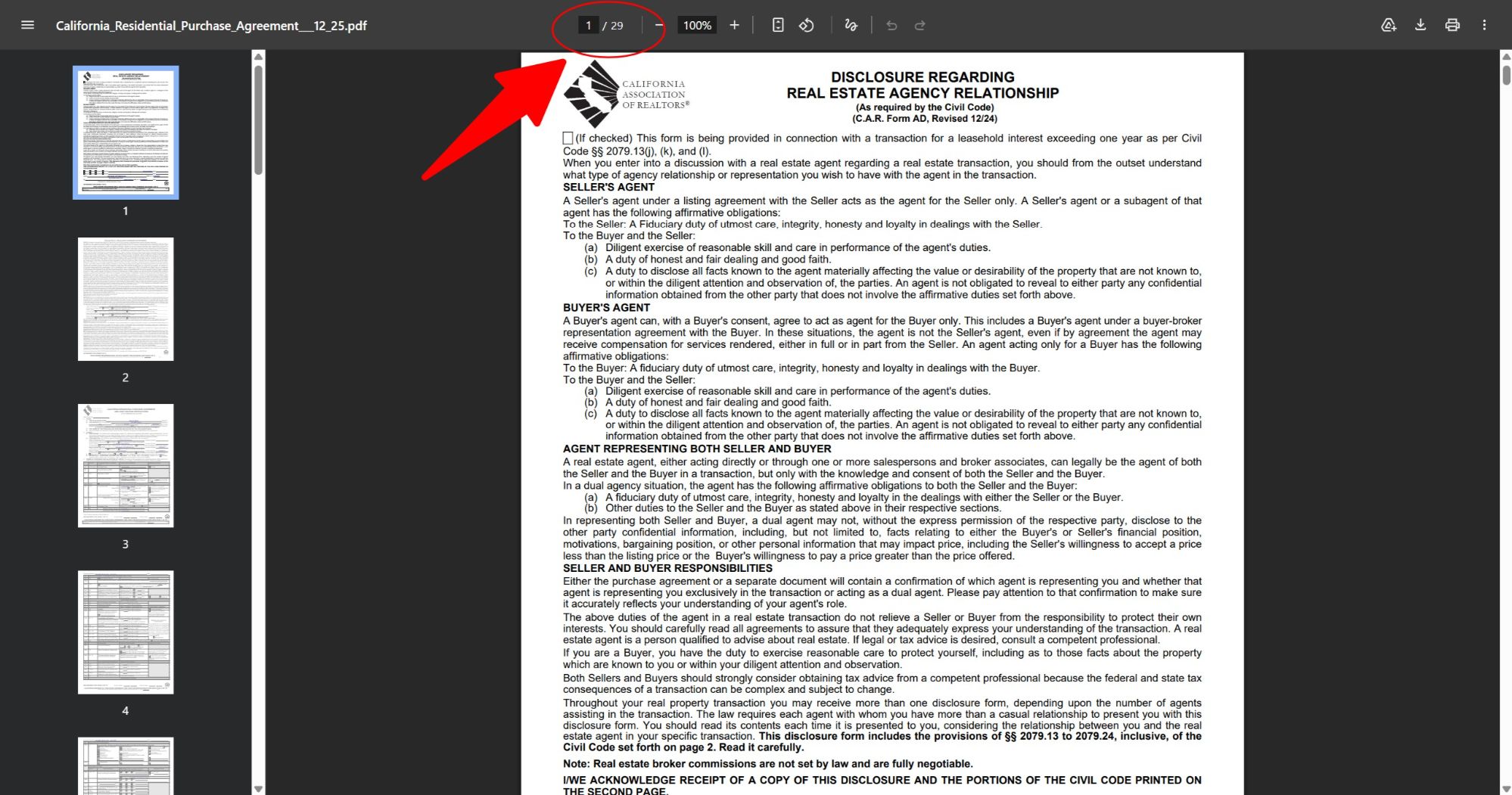
This is the actual file count from a real transaction, 29 pages total, with the 17-page purchase agreement making up the part where the negotiated terms actually live.
TLDR, the 3 things that matter most:
- Timeframes start counting down the moment your offer is accepted, not when you feel ready.
- Your inspection contingency is your strongest protection. It lets you cancel for any reason. Once it's gone, canceling gets harder.
- Liquidated damages cap how much of your deposit a seller can keep at 3% of the purchase price on an owner-occupied home of four units or fewer, and often far less than that once your actual deposit amount is factored in.
What Are Your Contingency and Offer Timeframes?
The clock starts the second your offer is accepted, whether you're ready for it or not.
Your offer itself has an expiration. It expires 3 calendar days after all buyer signatures unless a different date and time is written in. If the seller doesn't respond in that window, your offer is effectively dead, as it becomes voidable unless everyone signs and agrees to extend the terms of the agreement.
Your contingency removal periods default to 17 days after acceptance. That covers your loan approval, appraisal, property investigation, insurance, and review of seller documents. Seventeen days sounds generous until you're juggling a home inspection, lender underwriting, and HOA document requests in the same week. Every one of these periods can be shortened or extended in your offer.
Your possession date isn't always your closing date. Possession defaults to upon notice of recordation, but sellers can negotiate to stay in the home for a set number of days after closing. If you're counting on keys the day escrow closes, get that confirmed in writing.
See it in the contract:
- Offer expiration and initial deposit amount, RPA Page 1
- Contingency removal timeframes and possession terms, RPA Page 2
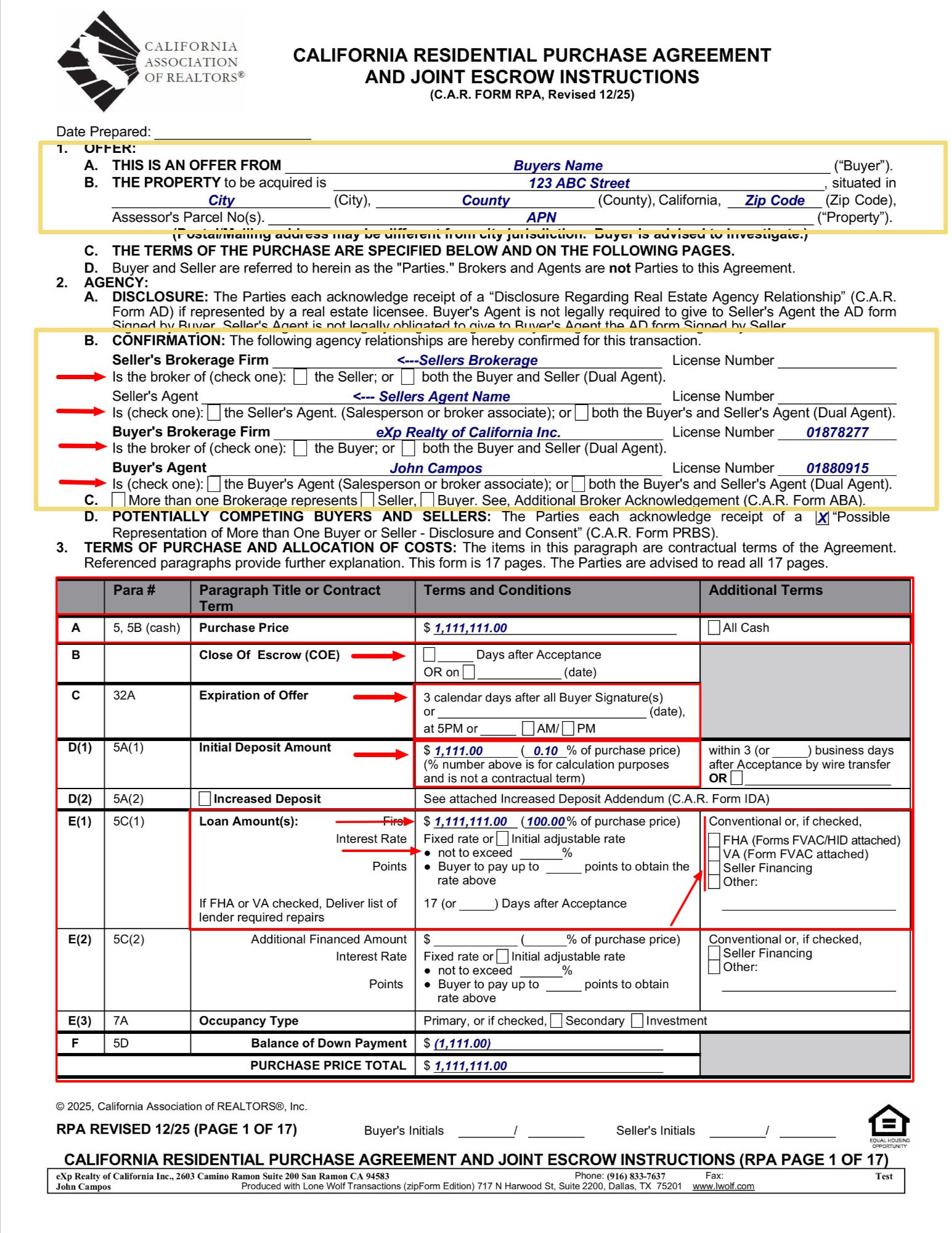
The red markup on this page highlights the 3-day offer expiration window and the initial deposit amount, the two dates that start your clock before you've even opened escrow.
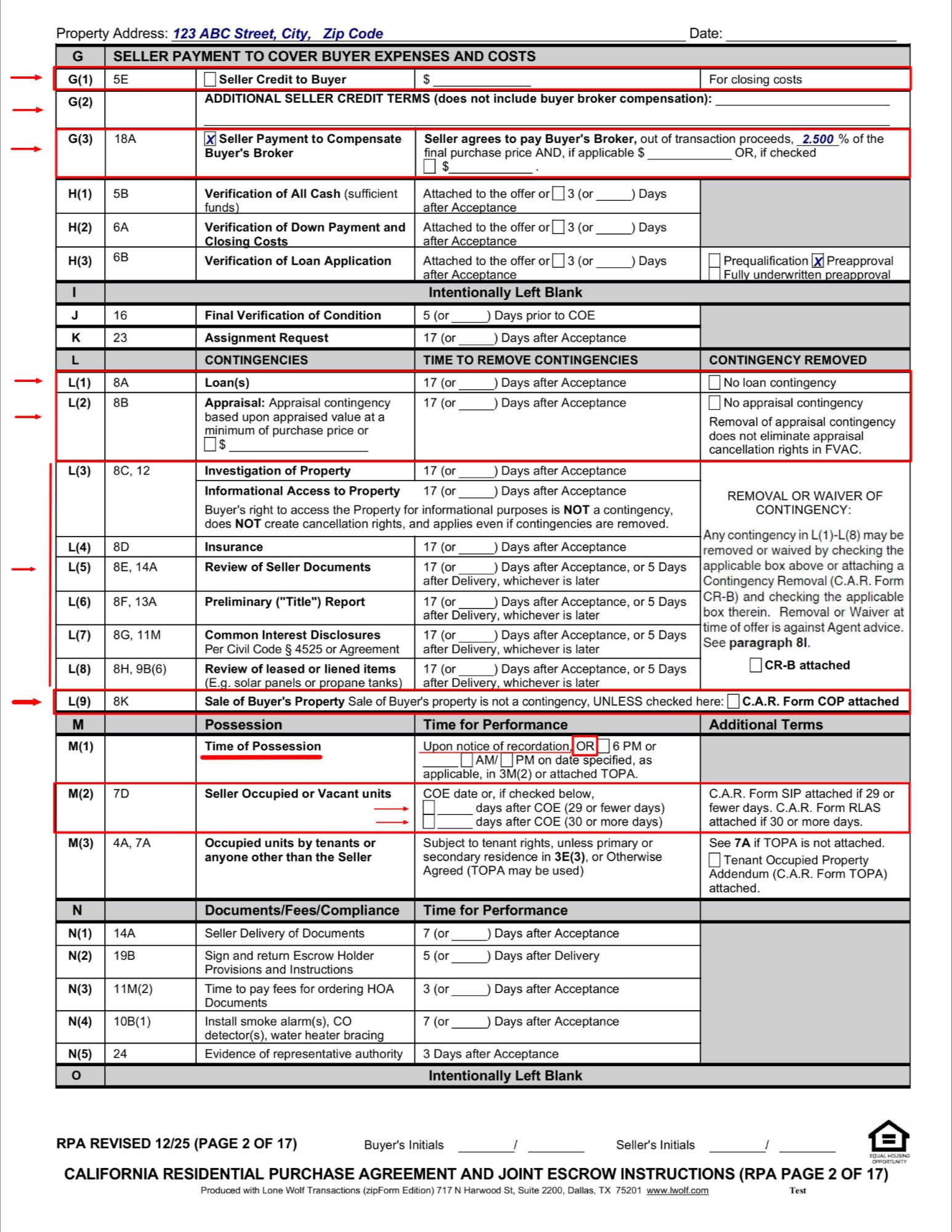
I've marked the 17-day contingency default and the possession terms here, since these are the two lines buyers ask me about most once escrow is already moving.
Which Contingency Actually Protects You?
A contingency gives you the legal right to cancel the contract and get your deposit back if a condition isn't met. Not all contingencies protect you equally, and the one that matters most is the one buyers understand the least.
Your inspection contingency is your get out of jail free card. During that window, you can cancel the agreement for any and all reasons, not just something wrong with the home. It's a low-pressure period built into the contract specifically so you can inspect the property without putting your deposit at risk. If you haven't already, this is a good time to read what inspections you should actually get when purchasing property. Use this window.
Once that contingency period passes or gets removed, the stakes go up. Canceling after that point requires cause, and proving cause as a buyer can get complicated fast. This is why removing a contingency at the time of offer is generally against agent advice. Once it's gone, it's gone.
A couple of details worth knowing while you're in this window:
- Appraisal contingency: If your offer includes a Financing and Value Addendum (FVAC), removing your standard appraisal contingency does not automatically remove the separate appraisal cancellation rights tied to that addendum.
- Selling your current home: This is never assumed as a contingency. It has to be built into the offer directly through a Contingency for Sale of Buyer's Property form, or you have no protection there at all.
See it in the contract:
- Full contingency table, including loan, appraisal, investigation, and sale of buyer's property, RPA Page 2
The arrows point to the loan, appraisal, and investigation rows, plus the sale of buyer's property line at L9, which is the one buyers most often assume is automatic and isn't.
How Much of Your Deposit Can a Seller Keep?
This is the section that gets skimmed fastest and costs the most if a deal falls apart.
Liquidated damages only applies if both buyer and seller initial it. By initialing, you're agreeing in advance to what happens to your deposit if you default on the purchase.
The 3% cap is what protects you. If the property has four units or fewer and you intend to occupy it, the amount the seller can retain is capped at 3% of the purchase price, no matter how large your actual deposit was. Anything above that has to come back to you.
A note on what this actually means for most buyers: 3% is a ceiling, not a guarantee. Signing this clause means the seller can only keep what was actually submitted to escrow as your deposit, not 3% of the purchase price by default. If your deposit was 1% of the purchase price, which is common, your exposure is limited to that 1%, not the full 3%. This is exactly why I recommend signing this clause in most cases. It protects you by design, not by accident.
Your deposit doesn't move without agreement either way. Release of funds requires mutual signed instructions from both buyer and seller, a judicial decision, or an arbitration award. Neither side can unilaterally walk off with the money.
One more thing buyers miss: if your deposit increases later in the transaction, a separate Increased Deposit form has to be signed specifically covering that new amount. Your original 3% cap does not automatically extend to a larger deposit added down the road.
See it in the contract:
- Liquidated Damages, Mediation, and Arbitration of Disputes, RPA Page 15
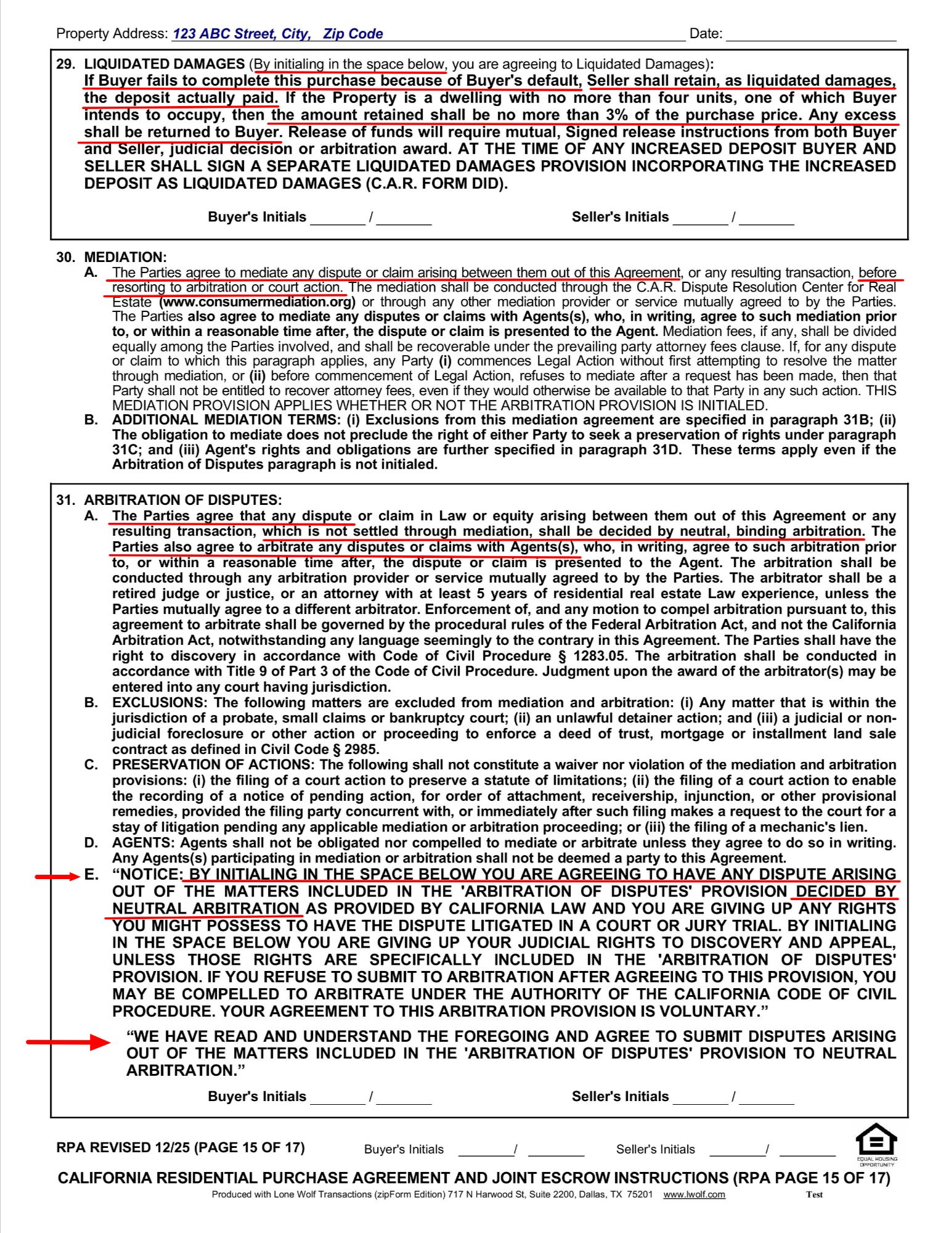
Notice the underlined 3% cap in Paragraph 29. That single line is what limits your exposure if the deal falls apart, and it's worth reading twice before you initial it.
What Actually Changed in the 12/25 RPA Revision
If you bought a home a year or two ago, the version of this contract you signed looked a little different. A few changes in this revision are worth knowing about specifically.
- Liquidated damages, mediation, and arbitration moved. These now sit directly before the signature pages, on Page 15 of 17, instead of being spread earlier in the document. That's not a legal change, but it does mean the clause you're most likely to gloss over is now the last thing you read before you sign, not something buried mid-contract.
- A new electrical system inspection advisory was added. Paragraph 11(E) now includes language required by Civil Code § 1102.6i, advising buyers to obtain an inspection of the home's electrical systems. If your agent hasn't brought this up separately, it's now built directly into the contract you're signing.
- New federal reporting language was added for certain cash and entity purchases. Paragraphs 19(H) and 19(I) now address reporting requirements under Treasury's Financial Crimes Enforcement Network rules, aimed at flagging potential money laundering. This mainly applies if you're buying as a trust or entity, paying all cash, or financing through a lender without existing reporting obligations. Implementation was pushed back to March 1, 2026, so this is still rolling out.
None of these changes affect your timeframes, your contingencies, or your deposit protection covered above. But if you're comparing notes with a friend who bought a year ago, this is why their contract reads a little differently than yours will.
See it in the contract:
- Liquidated Damages, Mediation, and Arbitration positioned right before the signature block, RPA Page 15
A Few More Terms That Affect Your Bottom Line
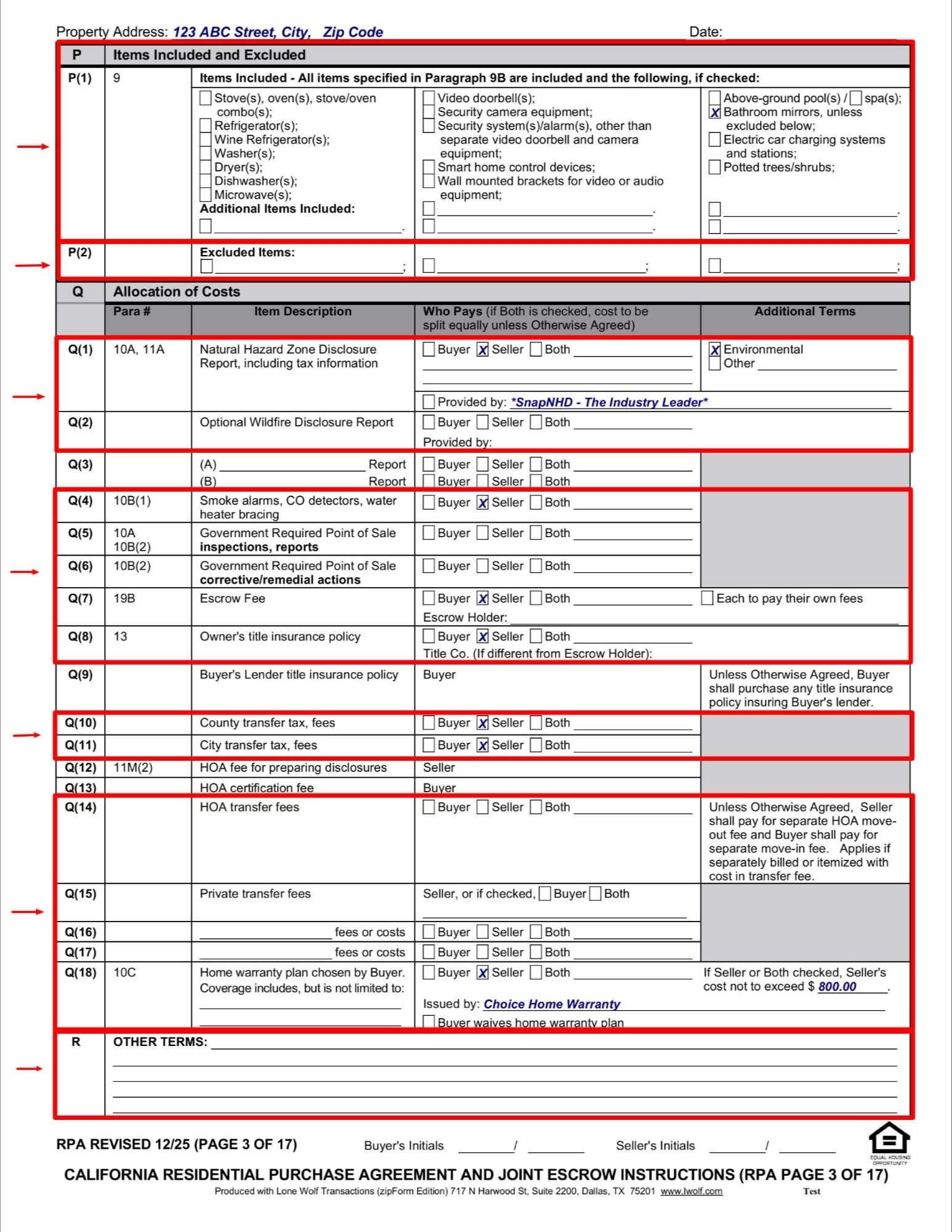
- Items included and excluded: Bathroom mirrors, EV charging stations, video doorbells, and above ground pools are not automatic. Get anything you care about checked in writing.
- Who pays what: Natural Hazard Disclosure reports, escrow fees, and owner's title insurance all have a customary payer around Sacramento, but every line is negotiable.
- Transfer taxes and HOA fees: County and city transfer taxes vary by location, and HOA transfer and certification fees can add several hundred dollars at closing. Ask early.
- Buyer broker compensation: This section spells out directly whether and how much the seller is compensating your buyer's agent. I covered this in detail after the 2024 industry changes in everything you need to know about the buyer representation and broker compensation agreement. Confirm this section is filled in clearly.
- Home warranty coverage: If a warranty is included, there's a dollar cap on what the seller or buyer owes toward it.
- Mediation before arbitration: Both parties must attempt mediation before arbitration or a lawsuit, or risk losing the right to recover attorney fees.
- Arbitration of disputes: Only applies if initialed, and it means giving up your right to a jury trial in favor of a binding arbitrator decision. Your right to discovery in arbitration is preserved under Code of Civil Procedure § 1283.05, and certain matters, like foreclosures under Code of Civil Procedure § 2985, are excluded from arbitration entirely and stay in the court system.
- Common interest disclosures: If the home is part of an HOA, review of these disclosures is governed by Civil Code § 4525 and gets its own contingency period, separate from your general document review.
See it in the contract:
- Items included and excluded, and full cost allocation table, RPA Page 3
- Buyer broker compensation, RPA Page 2
I've boxed t he full cost allocation table here, from the Natural Hazard Disclosure report down to transfer taxes and HOA fees, so you can see at a glance which of these are already customary in the Sacramento area and which are open for negotiation.
Key Takeaways
- Your offer and contingency clocks start the moment your offer is accepted, not when you're ready.
- Your inspection contingency is your strongest protection. Use that window before you remove it.
- A seller can keep no more than 3% of the purchase price as liquidated damages on an owner-occupied home of four units or fewer.
- Selling your current home is not a built-in contingency. It has to be added separately.
- Every cost allocation line in the contract is negotiable, not fixed.
One important note: I am a REALTOR, not an attorney. This article is general information, not legal advice. Please consult a qualified professional about your specific situation.
Frequently Asked Questions About the California Purchase Agreement
How many days do I have to remove contingencies on a California purchase agreement?
The default is 17 days after acceptance for loan, appraisal, and investigation contingencies, though this number can be negotiated shorter or longer in the offer itself.
Can a seller keep my entire earnest money deposit if I back out?
Only up to 3% of the purchase price on an owner-occupied home of four units or fewer, and only if both parties initialed the liquidated damages section. In practice, it's usually limited to your actual deposit amount, which is often closer to 1%.
Is selling my current home automatically a contingency in my purchase offer?
No. It only becomes a contingency if a separate Contingency for Sale of Buyer's Property form is attached and checked in the offer.
Work With Your Realtor
If you're working through a purchase agreement anywhere in Natomas, Elk Grove, Roseville, Folsom, West Sacramento, or South Sacramento and want to go through your timeframes, contingencies, and deposit terms line by line before you sign, I'm happy to walk through it with you. Schedule a free consultation.
Categories
Recent Posts




GET MORE INFORMATION

REALTOR® Lic# 01880915